
Rating Methodology
This page provides a brief overview only. For further details, please refer to the technical documents available on the Policies and Procedures page.
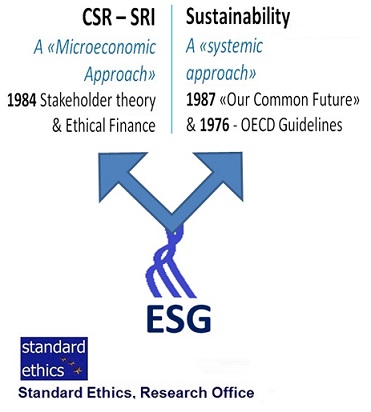
Standard Ethics adopts the notion of Sustainability as defined in the 1987 Brundtland Report, entitled ‘Our Common Future’ and presented to the United Nations with the message: ‘Development that meets the needs of the present without compromising the ability of future generations to meet their own needs’. Sustainability therefore represents a global challenge, rooted in human knowledge and essential for tackling the major climatic, social and economic phenomena that transcend national borders and the limits of individual companies.
Standard Ethics believes that Sustainability means aligning business activities with a shared global effort. For this reason, its Model is based exclusively on the principles and guidelines established by the European Union, the OECD and the United Nations — not on the voluntary and self-determined initiatives characteristic of Corporate Social Responsibility (CSR), nor on the best practices of a single market sector.
Only by measuring this alignment using comparable, transparent and independent methodologies is it possible to determine the degree of Sustainability of an economic entity and its impact on future generations.
The Standard Ethics Rating (SER)
The Standard Ethics Rating (SER) is based on a Proprietary Algorithm that incorporates five international standards and a forward-looking variable, ‘k’ (Sustainability at Risk). The calculation produces the G Aggregate (the governance of Sustainability), which determines, to a greater or lesser extent, the final rating.
.

The rating incorporates three factors: E (Environmental), S (Social) and G (Governance).
The G factor is the aggregate (Primary Factor), calculated by the Proprietary Algorithm on the basis of 5 standards, 35 indicators (Markers) and 119 possible parameters.
The E and S factors constitute the Secondary Factor: they are calculated separately, using two dedicated checklists, and influence the calculation of G at a specific stage — when the value of E or S reaches a minimum threshold, certain ‘conditional’ Markers of the Primary Factor may be assigned the most favourable option; otherwise, the option remains limited to the less favourable one. This is the mechanism through which the E and S components—while remaining independent measures published separately—are incorporated into the calculation of G.
For information on the calculation of the relative weights of E, S and G, and for a more detailed explanation on how the G Aggregate is determined, please visit the Talk to Us page. In the subject line of your message, select General information.
Standard Ethics Algorithm©
To ensure accuracy and comparability, Standard Ethics does not limit itself to analysing separate KPIs, which are weighted and summed algebraically – as is often the case with scoring systems – but integrates each indicator, referred to as a ‘Marker’, into its own six-variable algorithm: five ‘Standards’ and a bonus variable known as ‘k’.

FcEU — Fair Competition (Fc): positively evaluates companies that compete and operate in the market fairly; conversely, it views negatively risk factors such as antitrust issues, investigations, fines or penalties, tax evasion, or privileged positions that could, in the long term, prove problematic.
SaEU-OECD — Shareholders’ Agreements (Sa) and Mw — Market Weight: linked to considerations typical of many long-term institutional investors, these analyse the significance of issues that are sensitive for minority shareholders or new shareholders — for example, Shareholders’ Agreements not justified by operational needs, double voting rights, the presence of a controlling shareholder, conflicts of interest and a lack of contestability.
IdEU-OECD — Independent Directorship (Id): examines the management framework, the management and control of ESG risks, reporting models, and factors such as the composition of the Board of Directors.
CgUN-OECD-EU — Corporate Governance and Sustainability (Cg): assesses the company’s alignment with strategies such as the Paris Agreement (COP21) for mitigating climate change or the OECD Guidelines for Multinational Enterprises.
k — Sustainability at Risk (SaR): a forward-looking variable, linked to the quality and independence of senior management bodies (Id), which measures the company’s ability to resiliently cope with future adverse events.
The relationship between these variables is significant: it would be incoherent for a company to present itself as sustainable by emphasising only environmental factors, whilst at the same time hindering investors’ activities due to a lack of transparency, or breaching market rules through unfair tax or competitive practices, or failing to uphold the principles of equal opportunities. As the OECD and the EU point out, a sustainability framework is only comprehensive if it includes all the factors that make a company a valuable asset for future generations.
The Model’s key assumptions
The correlations between the 5 Standards are linear: non-linear relationships are not incorporated into the Model (a known and stated methodological limitation).
The Model is sector-agnostic: the 5 Standards are given equal weight regardless of the entity’s industry, which ensures the absolute comparability of ratings across different industry sectors.
In the absence of direct data, the Agency uses estimates (proxies) based on a conservative approach: where a data point is missing, the corresponding indicator is assigned the minimum value. This reduces the risk of overestimation, but may penalise entities with poor ESG reporting not because of a lack of adequate practices, but because of a lack of adequate disclosure.
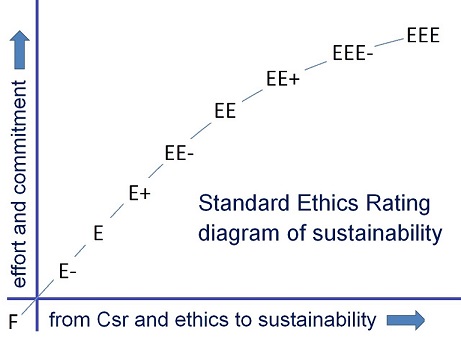
The final rating is expressed on a nine-notch scale: entities with G-Aggregate values that are close to a specific baseline receive the same rating as entities with values further from the baseline (a known and stated methodological limitation).
The process is entirely Analyst-driven: Artificial Intelligence is NOT used in data collection or in the rating process, for either solicited or unsolicited Standard Ethics Ratings (SER).
The Proprietary Algorithm assesses all these elements and weights them evenly, making the Standard Ethics Rating (SER) a best practice in comparative sustainability analysis — published and updated several times a year.