
ESG Definitions
Definitions adopted by Standard Ethics
- Sustainability
- Corporate Social Responsibility
- ESG rating
Why these definitions
- ESG measurement
- Measuring Corporate Social Responsibility
- Measuring Sustainability
Definition of Sustainability
Sustainable Development policies are about the generations of the future; they have taken on a global dimension and they are implemented on a voluntary basis. It is up to the main supranational organisations, officially recognised by nations across the globe, to establish the definitions, guidelines and ESG strategies related to sustainable development through science.
Economic entities pursue – to the extent deemed possible – aims, strategies and guidelines on Sustainability, they do not define them.
Definition of Corporate Social Responsibility
It is a voluntary ESG action or strategy, defined by the company or investor implementing it. It may be based on valuable ethical choices arising from dialogues with stakeholders. It may not be sustainable and, therefore, not aligned with international guidelines.
“Responsibility” is not a rateable notion.
Definition of an ESG Rating
Measuring Sustainability means providing comparable and independent data on the overall compliance of economic entities with international guidelines.
Why these definitions
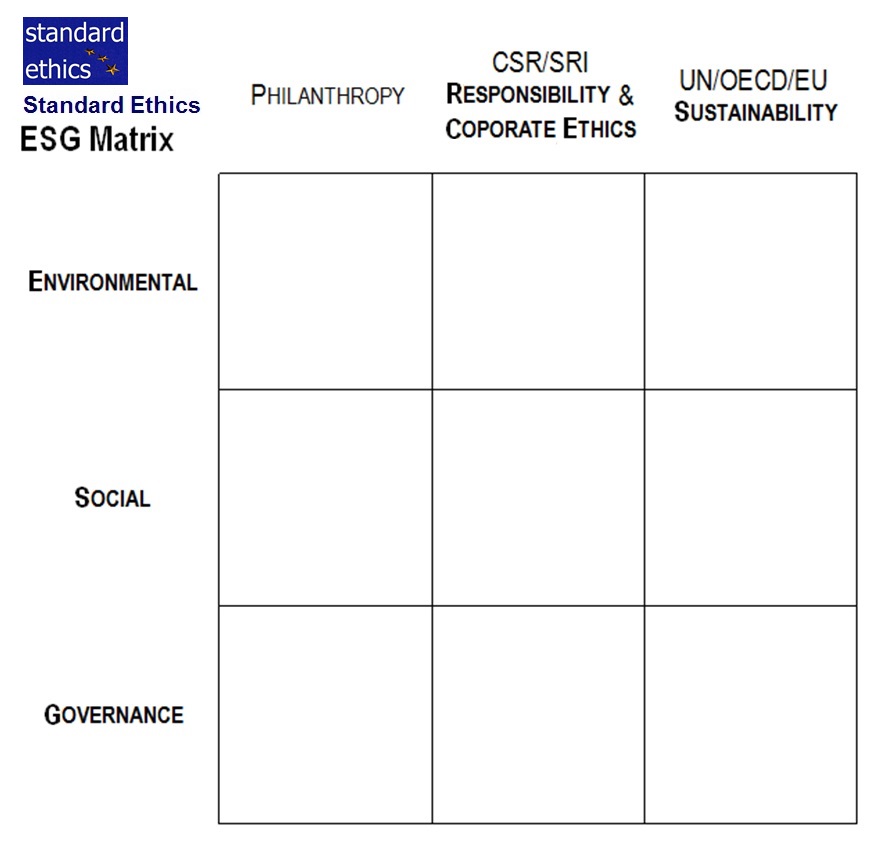
From the 1970s onwards, ‘extra-economic’ values relating to the environment, society and governance have gained increasing prominence in the business world. In practice, however, this space has been occupied by two very different approaches — which are rarely clearly distinguished: on the one hand, Corporate Social Responsibility (CSR) and Socially Responsible Investment (SRI); on the other, Sustainability. Even before developing a rating methodology, Standard Ethics felt it was necessary to separate these two concepts, because choosing one over the other has very concrete operational consequences.
Two models, two focal points
In CSR and SRI, the focal point of the system is the company — or the investor. This is the starting point for observation, and it is the stakeholders who revolve around it. This approach is rooted in stakeholder theory and leaves the company — or the fund manager — free to choose what ‘responsible’ contribution to make to social and environmental issues, often through its own Materiality Matrix.
Standard Ethics defines this as a ‘Ptolemaic’ model: those making non-economic decisions perceive themselves as the centre of their own universe, and from there determine the geography of the interests at stake. From this perspective, ESG policies may also include highly subjective ethical, religious or culturally sensitive elements — because it is the company itself that decides.
Sustainability stems from a different perspective. The earliest traces date back to 1976, with the OECD Guidelines for Multinational Enterprises — a tool that still lacked a unified strategic framework. It was in 1987, with the United Nations Brundtland Report, that sustainability found its definition: development that meets the needs of the present without compromising those of future generations. A ‘Copernican’ vision: those taking action no longer consider themselves at the centre of their own world. It is no longer the company that sets ESG priorities, but global decision-makers — the international organisations to which states, and ultimately citizens, have delegated the task of charting a common course in the interests of humanity and future generations.
Standard Ethics has been developing its model since 2004 and has chosen to keep these two approaches distinct — rather than conflating them, as is often the case in the ESG assessment market. For further information, please click the Agency Profile here.
The Paradox of Measuring Responsibility
CSR relies on stakeholder theory: each company defines its own objectives and priorities, typically through a bespoke Materiality Matrix. The result is a group of ‘responsible’ companies, each following its own methodology — which cannot be compared with one another as a whole, as there is no shared benchmark.
Individual indicators or specific themes can be compared using reporting frameworks or sectoral medians. But the sum of partial measures does not produce a comparable holistic measure: the detailed analysis may be rigorous, yet — to echo an insight by the mathematician, Bruno de Finetti — it says nothing as a whole. This is not a limitation of CSR per se: its purpose is not to construct a compliance rating, but to provide data tailored to the – often arbitrary – choices of SRI investors, who are free to decide what to include and exclude. The paradox is that an ‘accountability’ assessment ends up revealing more about the strategy of the assessor than that of the companies under scrutiny.
Measuring Sustainability: a shared roadmap
Sustainability, by contrast, requires a single, shared point of reference — UN, OECD and European Union guidelines — which enables an objective, consistent and ethically neutral comparison. It is like measuring the distance of different planets from the same gravitational centre: the targets are chosen neither by the entity being assessed nor by the assessor, but are established at a global level. Only in this way can the data be processed through a standard algorithm, applied uniformly to all entities.
Only matters that fall within the sustainability objectives defined by those global decision‑makers are considered relevant. To take a deliberately provocative example: alcohol consumption would be included if the United Nations classified it as a sustainable development issue — whereas an individual’s private life, not being an ESG matter, would remain outside the scope.
In 2004, Standard Ethics identified five macro‑variables — unchanged since their introduction — which form the basis of its Proprietary Algorithm. These indicators are designed to reveal the underlying nature of the entity with the lowest possible margin of error, rather than to measure isolated quantitative impacts. This leads to a central feature of the Model: modern science distinguishes between the domain of data collection and the domain of those tasked with interpreting that data, offering an opinion and formulating a hypothesis. It is this latter function that produces the rating. Clients do not commission an analysis merely to obtain numbers, but to receive an interpretation — an independent third‑party opinion on where the entity is positioned along the Sustainability roadmap.