
Corporate Bodies
For information on the ownership structure, click on Governance
Board of Directors
Standard Ethics Europe
Standard Ethics Europe’s governance structure comprises a governing body and operational departments. The Board of Directors guides the development and implementation of corporate strategies. It is not involved in the assignment of ratings. It is composed of five members, with equal representation of both genders and professional diversity, all of whom possess a high level of expertise; they are appointed for a two-year term, which expires upon approval of the 2027 annual accounts.
Non-independent, non-executive
Designation as non-independent also stems from his role as a director of both Standard Ethics Ltd and the Agency.
Jacopo Schettini Gherardini, Italian
President and CEO
 Graduated in Political Sciences, Strategic Studies (MSc), Ph.D. in Corporate Finance, Doctoral School of Finance, University of Trieste. He started his professional career working for HSBC in London (1992), covering all major derivatives markets: LIFFE (UK); CBOT (US); MATIF (France); DTB (German); CME (US). He also worked for other banks (like IMI Bank in London, owned by the Italian Ministry of Finance) before joining AEI in 2001 as CEO. Then, he began to focus intensely on such issues as corporate governance, corporate social responsibility and sustainable development. He became Directeur Exécutif of Standard Ethics AEI GEIE (Brussels) in 2004. Head of Research Office and CEO of Standard Ethics from 2013 to 2026.
Non-independent, non-executive
Designation as non-independent stems from her role as a director of both Standard Ethics Ltd and the Agency.
Orla Ralph, Irish
Director
 Senior financial services executive with over 30 years’ experience in Italy managing a number of start-ups in insurance and reinsurance including Swiss Re, Aegon, Nationwide Global, Assurant Solutions, as well as working for Visa and the Edison Group (formerly Homeserve/Assistenza Casa). Currently a Director of Kube Partners, an international consultancy that designs and develops innovative technological solutions (antifraud, dynamic pricing) for insurance companies, brokers and banks. For the past 10 years she has acted as a consultant for Enterprise Ireland, the government agency responsible for the development and growth of Irish enterprises in world markets. In 2024 she became a founder member of the Irish Business Network Italy (IBNI) whose mission is to build a professional community to promote and strengthen economic cooperation and synergies between businesses in both countries. She is married to an Italian academic.
Non-independent, non-executive
Designation as non‑independent reflects his position as a director within companies of the Class Editori Group, including Global Finance Rating Services Srl; one of Standard Ethics Ltd's shareholders, where he serves as a director without delegated powers.
Gabriele Capolino, Italian
Director
 Gabriele has a degree in Economics and is a Chartered accountant and Auditor. He was hired as a journalist in Milano Finanza, the economic and financial newspaper in 1986 and became Editor and Associate Publisher in September 1999. He serves in the Board of Directors of Class Editori Spa, the holding company of Milano Finanza, a public company since 1998, and in the board of other Group subsidiaries, including the American monthly magazine Global Finance, the satellite television companies Class-CNBC and E-Class, business data and information provider to banks and other financial institutions. He is past President and current member of the Executive Board of the European Business Press, the Association of European economic and financial newspaper publishers, which includes 52 newspapers, websites and magazines from 27 different countries.
Independent, non-executive
Mavie Cardi, Italian
Director

Graduated in Economics and Business Management from LUISS Guido Carli University in Rome, where she subsequently obtained a PhD in Business Law. In 2024, Mavie was awarded the National Academic Qualification as a Full Professor of the Economics of Financial Intermediaries. She has been an Associate Professor of the same subject at Link University in Rome since 2019. She is also the author of monographs and articles in academic journals on public and private financial institutions, the regulation and management of banking crises, European banking supervision and sustainable finance.
Independent, non-executive
Massimo Mariani, Italian
Independent Director (Compliance)

Full Professor of Corporate Finance (ECON-09/A) since 2019 at the LUM “Giuseppe Degennaro” University in Casamassima (Bari). He is responsible for the courses on Sustainable Finance, Advanced Corporate Finance and Global Sustainability, and Green Finance within the international PhD programme “Economics and Management of Sustainability and Innovation”. Author of numerous academic papers on sustainability and climate risk management, published in international journals such as *Business Strategy and the Environment*, *Corporate Social Responsibility and Environmental Management* and the *Journal of Environmental Management*. His main research areas focus on the impact of greenhouse gas emissions on the cost of capital, green bonds and the integration of ESG criteria into corporate strategies. Winner of the Best Paper Award at the Social Impact Investments International Conference in Rome for a scientific study, co-authored with others, on the cost of debt in relation to GHG emissions by large European companies. In 2012, he authored the monograph *Environmental Finance*, published by EGEA. Reviewer for internationally renowned scientific journals on sustainability issues, including, for example, the *Journal of Business Ethics*; *Energy Economics*; *Journal of Environmental Management*; and *Corporate Social Responsibility and Environmental Management*.
Standard Ethics Europe: organisational structure and rating process
Standard Ethics Europe’s staff (within the Flower Pattern below) comprises 12 people, spread across the analytical functions — the SOL Office and the UNSOL Office, dedicated respectively to solicited and unsolicited Standard Ethics Ratings — and the communications and client relations functions (the COMM Office and the Relations Officer). Other outsourced and non-integrated functions — such as administrative, IT support and regulatory and legal functions, do not take part in the rating process. This also applies to the Board of Directors.
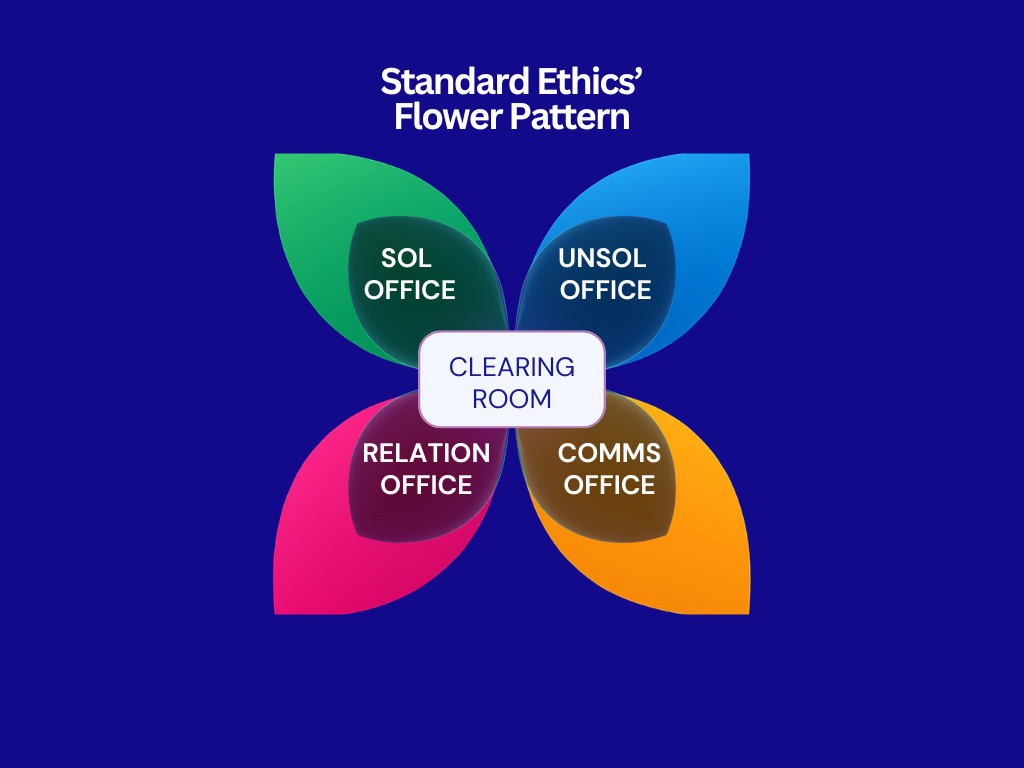
Every member of staff - integrated into the Flower Pattern - is subject to internal policies on the management of conflicts of interest, periodic declarations of independence and a system for vetting their positions (Security Clearance). This applies to the Board of Directors and, to a varying extent, to outsourced functions.
Standard Ethics Europe organises its operational processes according to a model of functional segregation known as the Flower Pattern: each operational function operates autonomously, separated from the others by strict information barriers (Chinese Walls), and linked to a coordination centre without any direct communication channels between the functions themselves. This architecture is designed to ensure that the commercial, analytical and communications functions do not interfere with one another at any stage of the process.
Two distinct approaches: solicited and unsolicited Standard Ethics Ratings (SER)
A Standard Ethics Rating (SER) has two possible origins. In the case of solicited SERs, it is the entity itself that formally requests the assessment, by signing an agreement which defines the rating terms. In the case of unsolicited SERs (where no entity involvement is required), the Agency independently identifies the entities to be assessed based on the public clusters it monitors for statistical and market intelligence purposes (please see Sustainability Clusters on Home page).
The methodology applied is the same in the two cases, and in both is Analyst-driven: there is no difference in the analysis criteria or in the thoroughness of the assessment process. The difference between the two rating types lies rather in the documentation provided to the rated entity: for solicited SERs, the Agency produces Guidelines, a detailed analysis shared during the evaluation process, and subsequently the Final Report, a document that accompanies the rating; for unsolicited SERs, which are based exclusively on publicly available sources, such documents are not provided and the Analyst uses the data solely for rating purposes.
Data collection
In the case of solicited SERs, data collection follows a structured process involving an initial meeting with the entity’s representatives and a dedicated phase for gathering information. In the case of unsolicited SERs, the Agency relies exclusively on public sources: financial statements, sustainability reports, institutional press releases, and decisions by regulatory and judicial authorities. In both cases, the sources used are always public or publicly available: the Agency does not use confidential data or non-institutional sources, such as non-governmental organisations, trade associations or the general media. Furthermore, it does not purchase data from third parties to carry out its assessments, nor does it sell its own data to third parties.
The analysis methodology
The analysis is divided into two sequential phases. The first phase assesses the entity’s adoption of environmental and social policies, objectives and certifications, yielding two separate scores for E and S. These scores are then used, in a specific step of the methodology, to feed into the second phase: the calculation of the governance of Sustainability aggregate (G), which integrates five areas of analysis — competition, fairness towards shareholders, market influence, independence of governing bodies and overall consistency with international sustainability strategies — using the Agency’s Proprietary Algorithm. The result of this calculation forms the basis of the final assessment.
All data collected is documented with its source and, where possible, verified against multiple independent references. The proposed rating drawn up by the Analyst is discussed in pre-established forums. In one instance, this is the Internal Rating Committee (IRC). The Committee takes the form of a Joint Operational Office Meeting. It is responsible for the final approval of ratings under the Ordinary Procedure. It is chaired by the Head of Operations, and attended by the Head of the SOL Office, the Head of the UNSOL Office and the Deputy Head of the SOL Office (a permanent alternate member who stands in in cases of conflict of interest). As an alternative to the Ordinary Procedure, rating proposals are discussed in the Clearing Room, a forum for operational discussion between the designated analysts, the Head of Operations and other colleagues. The Clearing Room is also a Joint Operational Office Meeting that involves the various functions involved in the process.
In both settings, the consistency and accuracy of the analysis are verified, the final rating is approved, and any override of the algorithmic result is authorised. There are numerous safeguards in place at the policy and procedural levels to ensure the independence of judgement and roles.
Dialogue with the rated entity
Prior to publication, the rated entity is given the opportunity to speak with the designated analyst, to verify the factual accuracy of the data collected. There is no opportunity to discuss the rating itself, which remains, in all cases, the exclusive prerogative of the Agency and is non-negotiable, whether for solicited or unsolicited Standard Ethics Rating types. In the case of solicited ratings, as already indicated, the rated entity also receives the Final Report, which it may choose to publish independently, on the understanding that the assessment content may not be altered.
The rating outcome
The final Standard Ethics Rating is expressed on a nine‑level letter scale and is accompanied by an Outlook. Where relevant, the assessment also considers any particularly serious events that occurred in the five years preceding the rating date, while consistently applying the principles of coherence and graduality that govern any adjustment to the rating.
Timelines and Updates
Typical processing times vary depending on the type of rating and the size of the entity, and are approximately one to two weeks (for solicited/unsolicited baseline analyses) and one to two months for solicited Corporate Standard Ethics Ratings, depending on the preparation of the documentation. Solicited ratings are valid for one year and are subject to a renewal process; unsolicited ratings remain valid until the next review. The Agency constantly monitors the rated entities to identify any significant events that may warrant a rating reassessment. A publicly available bi-monthly calendar lists, in advance, the ratings already scheduled for review.
Complaints and appeals
Rated entities may, at any time, report any factual inaccuracies in the data used and, if they disagree with the rating outcome, lodge a formal appeal, which will be examined by a body separate from the one that made the original decision.
Compliance function
In accordance with Article 15 of Regulation (EU) 2024/3005, the Agency is establishing a permanent and independent compliance function. Under the temporary arrangements in force from 2 July 2026 until 2 July 2029, this function may be carried out by the independent director; Massimo Mariani, pending the appointment of a dedicated staff member. For a description of the role and responsibilities of the compliance function, please refer to the Policies and Procedures page. The Agency has drawn up a transition plan providing for the appointment of a Compliance Officer from the twenty-fourth month of the temporary regime, to ensure a gradual integration into the corporate structure.